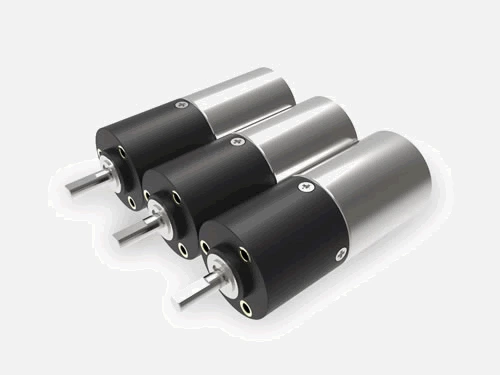
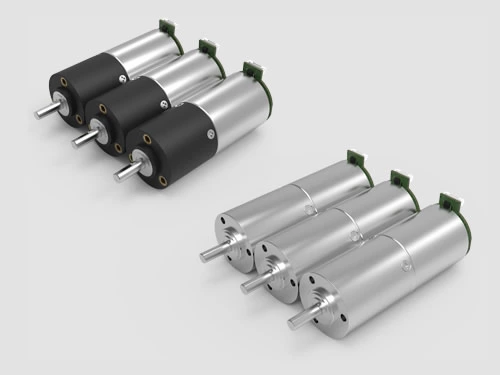
With the variety of gear motors available on the market, it can be difficult for newcomers in the gear motor industry to understand the functions of each type of gear motor.
This often leads to a longer learning process and gradual knowledge accumulation in practical engineering applications.
This article focuses on one of the most common types of gear motors — the planetary gear motor — and explains its structure, working principle, and main functions.
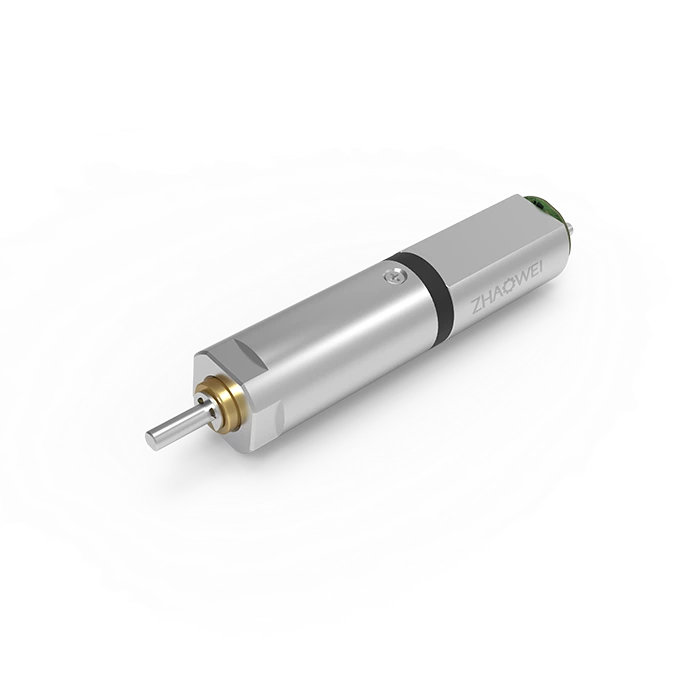
A planetary gear motor is a commonly used reducer. Its main transmission structure consists of a planetary gearbox and a drive motor. It is also known as a planetary reducer or gear reducer.
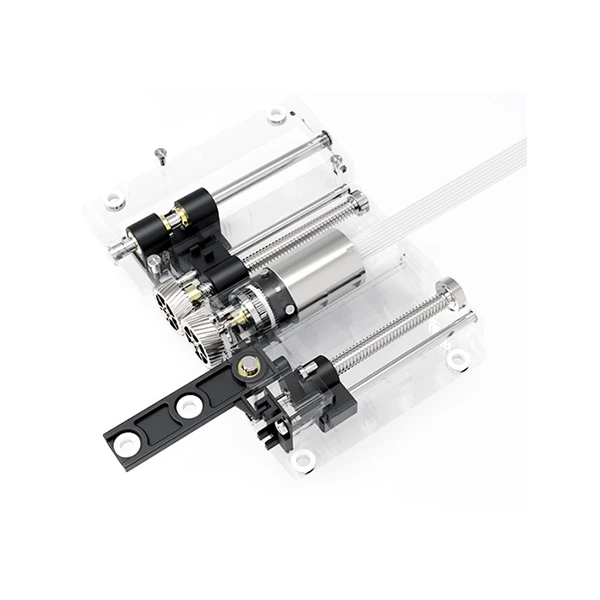
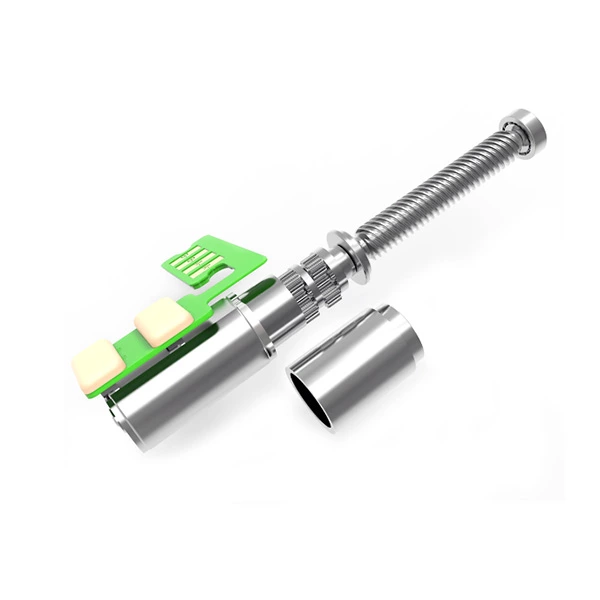
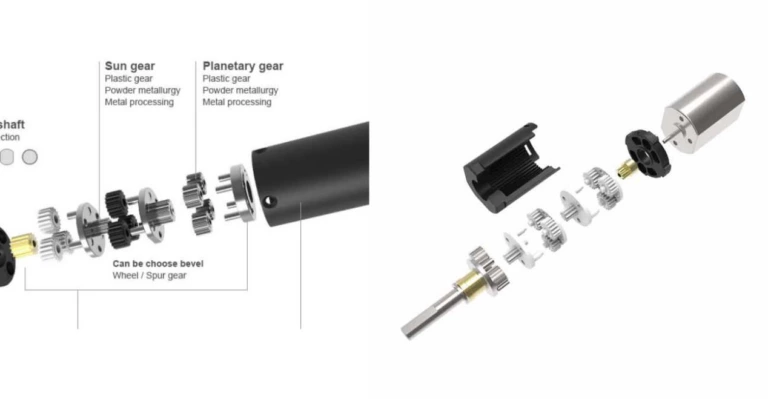
The planetary gearbox (planetary gearheads) consists of planetary gears, sun gears, a ring gear, and planet carriers. The drive motor can use a DC motor, stepper motor, coreless motor, or electric motor as the power source.
The micro planetary gear motor is mainly used to reduce speed, increase torque, and reduce inertia ratio, making it suitable for precision motion systems.
Structure of Planetary Gear Motor
Planetary gearheads normally consist of three main components: a sun gear, planet gears (also called satellite gears), and a ring gear.
The sun gear is located in the center of the system, while the planet gears orbit around it and receive torque from the sun gear.
The ring gear is integrated into the housing and meshes with the planet gears to complete the transmission process.
This structure is widely used in micro planetary gear motors due to its compact size and stable torque transmission capability.
How Do Planetary Gear Motors Work?
When the sun gear rotates under the drive of the motor, the planet gears mesh with it and begin to rotate around the sun gear.
At the same time, the planet gears also engage with the ring gear on the inner wall of the gearbox housing.
Under this combined motion, the planetary gears perform both rotation and revolution, transmitting torque through the gearbox system.
Most planetary gearboxes include multiple planet gears, which help distribute load evenly and improve operational stability.
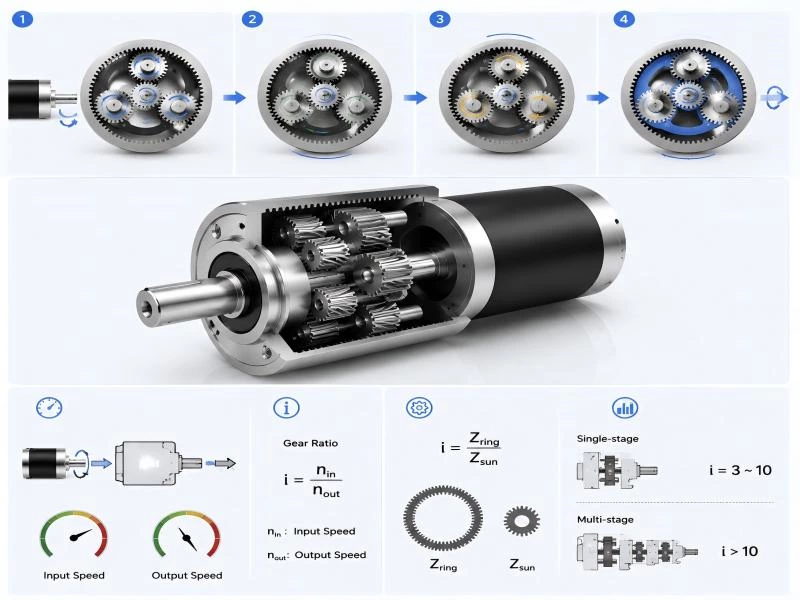
The input speed of the planetary gearbox motor (sun gear speed) is higher than the output speed, which is why it is called a planetary gear reduction motor.
The speed ratio between input and output is called the reduction ratio or gear ratio, usually represented by the letter “i” in technical specifications.
The gear ratio is determined by the number of teeth on the sun gear and ring gear.
For single-stage planetary gear reducers, the gear ratio is typically between 3 and 10.
When a higher reduction ratio is required (above 10), multi-stage planetary gearheads are used.
Advantages of Planetary Gear Motors
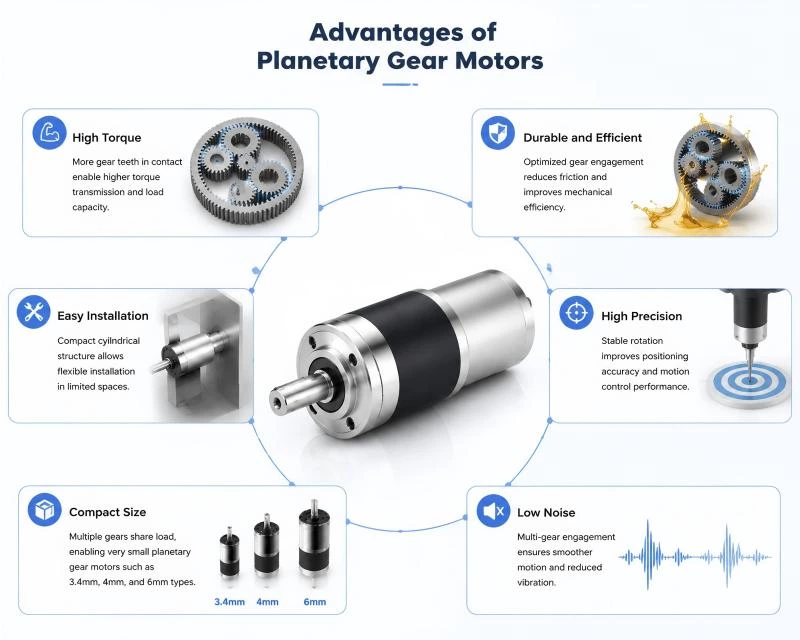
- High torque: With more gear teeth in contact, planetary gear motors can transmit and withstand higher torque in a balanced way.
- Durable and efficient: Optimized gear engagement reduces friction and improves mechanical efficiency.
- Easy installation: The compact cylindrical structure allows flexible installation in limited spaces.
- High precision: Stable rotation improves positioning accuracy and motion control performance.
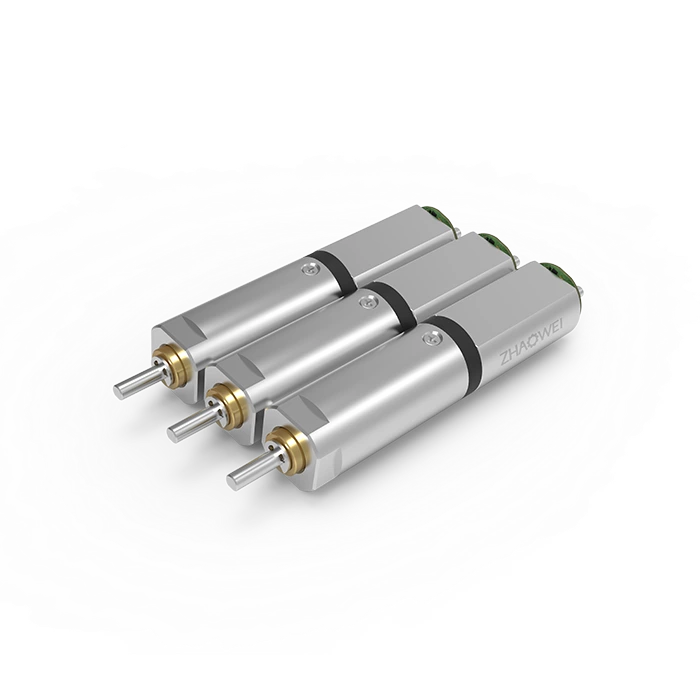
- Compact size: Multiple gears share load, enabling very small planetary gear motors such as 3.4mm, 4mm, and 6mm types.
- Low noise: Multi-gear engagement ensures smoother motion and reduced vibration.
Applications of Planetary Gear Motors
Planetary geared motors with 12V and 24V DC planetary gearheads are commonly used in modern industrial and intelligent systems where compact structure, stable torque output, and precise motion control are required.
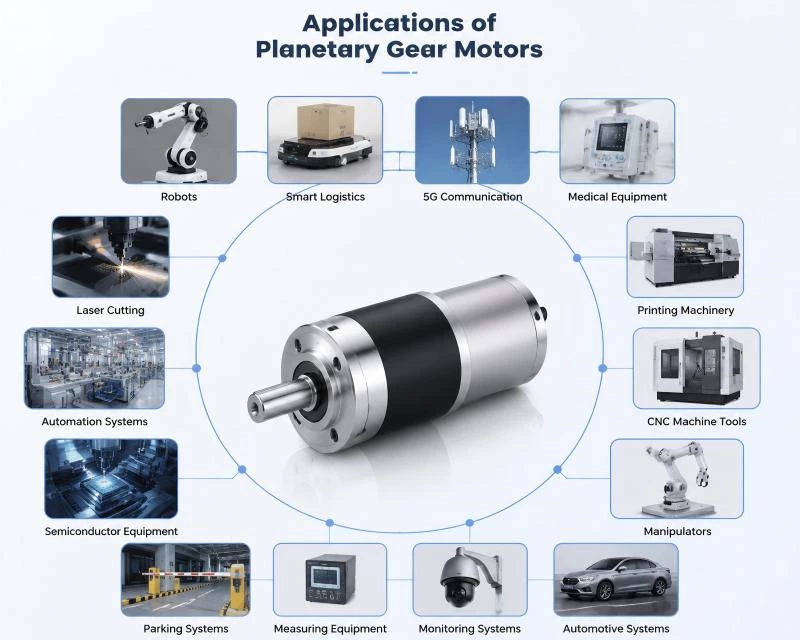
These systems are widely applied in digital products, intelligent robot transmission systems, 5G communication equipment, smart logistics, smart cities, smart automobiles, printing machinery, flame cutting equipment, laser cutting systems, CNC machine tools, tool machinery, food packaging equipment, automation industry systems, aviation equipment, semiconductor equipment, robots, manipulators, communication equipment, pharmaceutical equipment, printing equipment, textile machinery, CNC pipe benders, parking systems, measuring equipment, precision monitoring systems, vehicle industry systems, and automatic control systems.
Why Planetary Gear Motors Are Widely Used
The wide adoption of planetary gear motors is mainly due to their high torque density, compact coaxial structure, and stable performance under load conditions.
These advantages make them suitable for robotics, automation, and precision motion control systems.
Customization Support
Depending on the application, parameters such as diameter, voltage, input speed, and torque need to be customized for optimal performance.
If gear motor customization is required, ZHAOWEI provides planetary gear motor solutions for different industrial applications.